ChatGPT vs Claude (2026): Same Price, Genuinely Different Tools
ChatGPT and Claude both cost $20 a month at the entry tier. They're the two most-used AI assistants on the planet, their flagship models score within a hair of each other on most benchmarks, and yet using them day to day feels nothing alike. So the real question isn't "which is smarter" — at the frontier, that gap has mostly closed. It's "which one is built for the work you actually do."
The one-line answer: Claude is the specialist — deeper at coding, writing, and reasoning over long documents, but text-only. ChatGPT is the generalist — it writes code and prose well and generates images, talks to you, browses the web, and runs a huge plugin ecosystem in one app. Pick Claude if your work is mostly text and code. Pick ChatGPT if you want one tool that does a bit of everything.
At a glance
| ChatGPT | Claude | |
|---|---|---|
| Entry price | $20/mo (Plus) | $20/mo (Pro) |
| Free tier | Yes — GPT-5.5 Instant, with ads in the US | Yes — Sonnet 4.6, no ads |
| Flagship model | GPT-5.5 | Claude Opus 4.8 |
| Next tier up | Pro $100 / Pro $200 | Max $100 / Max $200 |
| Context window (chat) | 128K (Plus) | 200K (Pro) |
| Context window (API) | 1M | 1M |
| Image generation | Yes (built-in) | No |
| Voice mode | Yes (advanced) | No native voice |
| Web browsing | Yes (deeply integrated) | Limited |
| Coding agent | Codex | Claude Code |
| Plugin / app ecosystem | GPT Store, thousands of GPTs | MCP (6,000+ integrations) |
| Best at | Versatility, multimodal, ecosystem | Coding, writing, long-context reasoning |
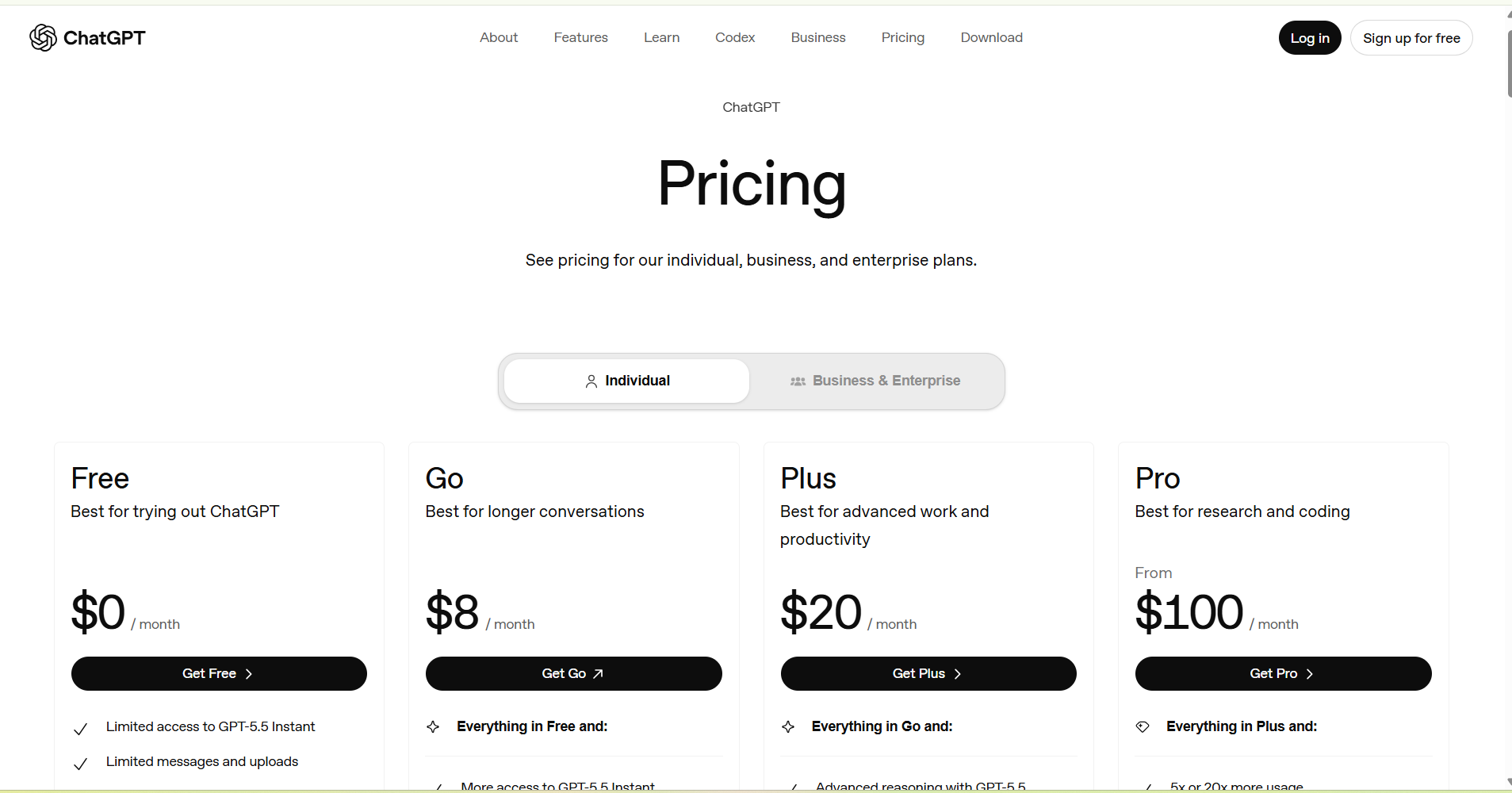
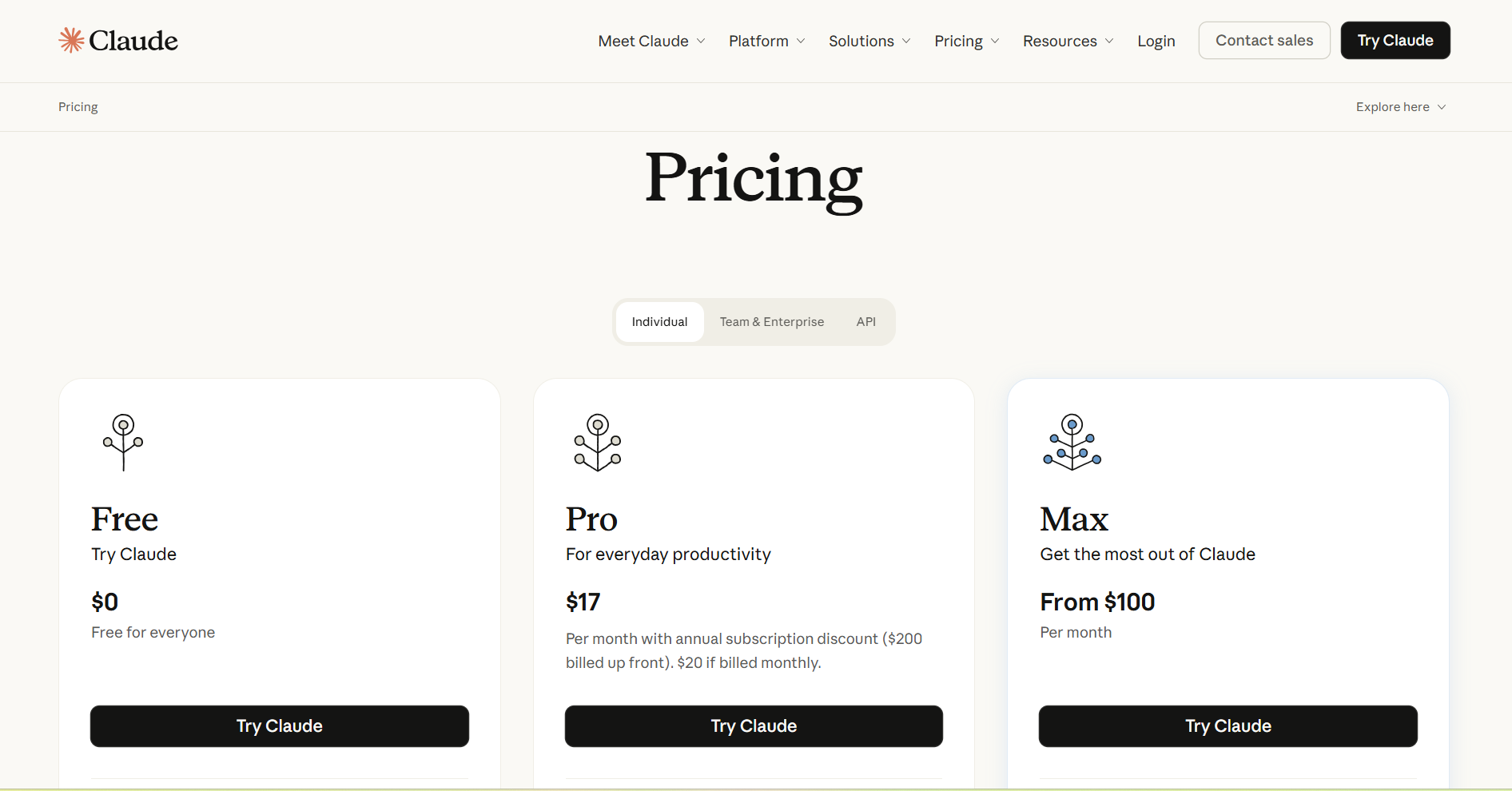
Pricing: identical at the door, different above it
Both start at $20/month — ChatGPT Plus and Claude Pro. At that tier the sticker price is a non-factor; the difference is what you get for it.
ChatGPT Plus ($20) gives you GPT-5.5 as the default model, image generation, advanced voice, web browsing, Codex, and Deep Research (capped at 10 runs/month). The free tier is usable but now carries ads in the US (since February 2026), and your conversations may be used for training unless you opt out.
Claude Pro ($20) gives you the flagship Opus 4.8 plus Sonnet 4.6, a larger 200K-token context window, Projects, and Claude Code — but no image generation, no voice, and only limited web search. The free tier runs on Sonnet 4.6 and is ad-free.
Above $20, the ladders look similar but differ in detail. ChatGPT now splits into Pro $100 (5x limits, launched April 2026 to sit directly against Claude Max) and Pro $200 (20x limits, 1M context in-app, Sora video). Claude offers Max $100 (5x) and Max $200 (20x). At the $100 tier, both give you the flagship model with 5x the entry usage — a genuine wash.
Verdict: Price is not the deciding factor here, and any comparison that says "X is cheaper" is out of date. They're matched at $20 and matched at $100. Choose on capability, not cost. In fact, because they're priced identically, a lot of professionals just run both $20 plans and use each for what it's best at — still less than one $200 plan.
Coding: Claude's clearest edge
This is the category with the least ambiguity. On the standard SWE-bench Verified benchmark the two flagships are nearly tied — GPT-5.5 and Claude Opus 4.8 land within a fraction of a point of each other. But on the harder SWE-bench Pro, which better reflects messy real-world repositories, Claude pulls clearly ahead (roughly 69% vs 59%). More telling than benchmarks: developer preference and market share. Surveys through 2026 consistently show developers favoring Claude for coding, and Claude has come to dominate the enterprise coding market — Cursor, the most popular AI code editor, uses Claude as its default model.
The practical differentiators are context and explanation. Claude's 200K-token chat window (1M via API) lets it hold entire codebases in a single conversation with little accuracy loss, which matters for debugging and multi-file refactors. And Claude tends to explain why it made a change, not just what it changed. Claude Code, included in Pro at $20, runs in your terminal, reads your whole repo, edits files, and runs commands locally — many developers call it the single biggest reason they pay for Claude.
ChatGPT's answer is Codex, included from Plus up. It runs in cloud sandboxes (faster setup, less local control), integrates tightly with GitHub and VS Code, and leads on some speed-oriented terminal benchmarks. It's genuinely good — but for the core loop of write-debug-ship, most developers still give Claude the edge.
Verdict: If coding is your primary use, Claude is the stronger pick — better on hard real-world tasks, larger usable context, clearer reasoning, and Claude Code in the $20 tier. ChatGPT's Codex is close and better if you're already living in the GitHub/VS Code ecosystem.
Writing: Claude for prose, ChatGPT for structure
The consensus among professional writers is consistent: Claude produces more natural prose. Sentence length varies, transitions flow, and tone-matching is more accurate, where ChatGPT can read as competent-but-formulaic. If you're drafting essays, narrative content, or anything where voice matters, Claude's output usually needs less de-roboting.
ChatGPT's strengths in writing are structure and tooling. Its Canvas editing workspace is more polished than Claude's Artifacts for side-by-side drafting and iteration, and it's strong at template-driven, structured content — outlines, formats, repurposing. It's also the better choice the moment your "writing" task includes generating an image or pulling live web data into the piece.
Verdict: Claude for quality prose and nuanced, human-sounding writing. ChatGPT for structured, template-driven content and any writing task that needs images, search, or its Canvas workflow.
Where ChatGPT wins outright: everything multimodal
This is the flip side, and it's not close. Claude cannot generate images, has no native voice mode, and only limited web browsing. ChatGPT does all three, built into the same chat:
- Image generation — built in; Claude has no equivalent, so you'd need a separate tool.
- Voice — ChatGPT's advanced voice mode handles natural back-and-forth conversation; Claude has none.
- Web browsing — ChatGPT searches and cites live sources mid-conversation; Claude's search is limited.
- Ecosystem — the GPT Store offers thousands of community-built specialized assistants you can use or build without code.
Claude's ecosystem counterpunch is MCP (Model Context Protocol), which connects Claude to 6,000+ applications and is excellent for agentic, tool-using workflows — but it's a different kind of strength (developer/agent integrations) than ChatGPT's consumer-facing breadth.
Verdict: If you want one assistant that generates images, talks, browses, and writes code in a single interface, ChatGPT is the only one of the two that does it. For multimodal versatility, it wins by default.
Reasoning and long context
On graduate-level reasoning (GPQA Diamond) Claude has held a measurable lead, and its long-context reliability is a repeated theme — it degrades less across a fully-loaded window than ChatGPT does. That matters specifically when you drop an entire repository, a multi-hundred-page contract, or a book-length manuscript into one prompt. ChatGPT's flagship, meanwhile, leads on agentic tooling and computer-use tasks, and its broader reasoning is excellent for everyday work.
Verdict: Claude for deep reasoning over large documents in a single pass. ChatGPT for agentic, tool-driven tasks and fast general reasoning.
Who should pick which
Choose ChatGPT if you:
- Want one tool that does images, voice, web search, and text in a single app
- Value the largest plugin/GPT ecosystem
- Do structured, template-driven writing or need Canvas
- Want the more generous, feature-rich free tier (ads aside)
- Need multimodal output as part of your everyday workflow
Choose Claude if you:
- Write code as a primary task (better on hard real-world coding, Claude Code included at $20)
- Care about natural, human-sounding prose
- Work with long documents, large codebases, or huge contexts in one pass
- Want an ad-free free tier and a privacy-forward posture
- Prefer a tool that explains its reasoning and admits uncertainty
The honest bottom line
At identical prices, this is a specialization choice, not a budget one. Claude is deeper — the better tool if your work centers on code, writing, or reasoning over big documents. ChatGPT is broader — the better tool if you want versatility and multimodal features in one place. Both are excellent in 2026, and the gap between either of them and everything else on the market is far larger than the gap between the two.
If you genuinely can't decide, the most common real-world answer is to run both $20 plans and route by task — Claude for the deep code-and-writing work, ChatGPT for images, voice, search, and quick everything-else. Two subscriptions still cost less than one premium tier, and most people find their preference sorts itself out within a week.
Frequently asked questions
Is ChatGPT or Claude cheaper? Neither — both start at $20/month (ChatGPT Plus and Claude Pro), and both offer $100 and $200 tiers above that. Price isn't a differentiator; capabilities are.
Which is better for coding? Claude, for most developers. It leads on hard real-world coding benchmarks (SWE-bench Pro), has a larger usable context window, and includes Claude Code in the $20 plan. ChatGPT's Codex is strong, especially in the GitHub/VS Code ecosystem.
Which is better for writing? Claude tends to produce more natural, human-sounding prose. ChatGPT is better for structured, template-driven content and anything that needs images or live web data mixed in.
Can Claude generate images? No. Claude is text-only — it can analyze images but not create them. ChatGPT generates images natively. If image generation matters, that alone may decide it.
Do they use the same models? No. ChatGPT runs OpenAI's GPT-5.5; Claude runs Anthropic's Opus 4.8 and Sonnet 4.6. The flagships score within a point of each other on most benchmarks but diverge by use case.
Should I use both? Many professionals do. At $20 each, running both and using each for its strengths (Claude for code/writing, ChatGPT for multimodal/ecosystem) costs less than a single $200 plan.
Related on Toolglade: Best AI Chatbots · ChatGPT vs Gemini · Claude vs Gemini · ChatGPT review · Claude review